The water changes the problem
Surface vessels and underwater vehicles share some software ideas with aerial drones, but their operating environments create different constraints. A surface craft moves among waves and other traffic while retaining access to above-water sensors and communications. A submerged vehicle faces pressure, limited visibility and a very different communications environment.
The first distinction is therefore physical, not promotional. An uncrewed surface vessel operates at the surface. An autonomous underwater vehicle is untethered and can carry out programmed work onboard. A remotely operated underwater vehicle normally connects to an operator through a tether. NOAA explains these categories through scientific systems whose constraints also help readers understand naval technology [1].
Three vehicle types, three supervision models
| Type | Physical arrangement | Information relationship |
|---|---|---|
| USV | Operates at the water surface | Above-water links; remote or supervised functions |
| AUV | Operates underwater without a tether | Onboard task execution; data may be retrieved later |
| ROV | Connected by a tether | Operator interaction and data through the cable |
“Uncrewed” describes the absence of people aboard. It does not establish complete independence from people ashore or on another vessel. A surface craft can be remotely operated, supervised or use autonomous functions at different stages. Likewise, an AUV can depend on substantial planning, launch and recovery support despite operating untethered during its survey.
Surface autonomy must work in a shared environment
A surface vessel needs to interpret its surroundings and behave predictably around others. A chart and a planned route are not sufficient descriptions of that capability. Changing traffic, sea conditions and equipment faults all influence what a useful supervision arrangement must provide.
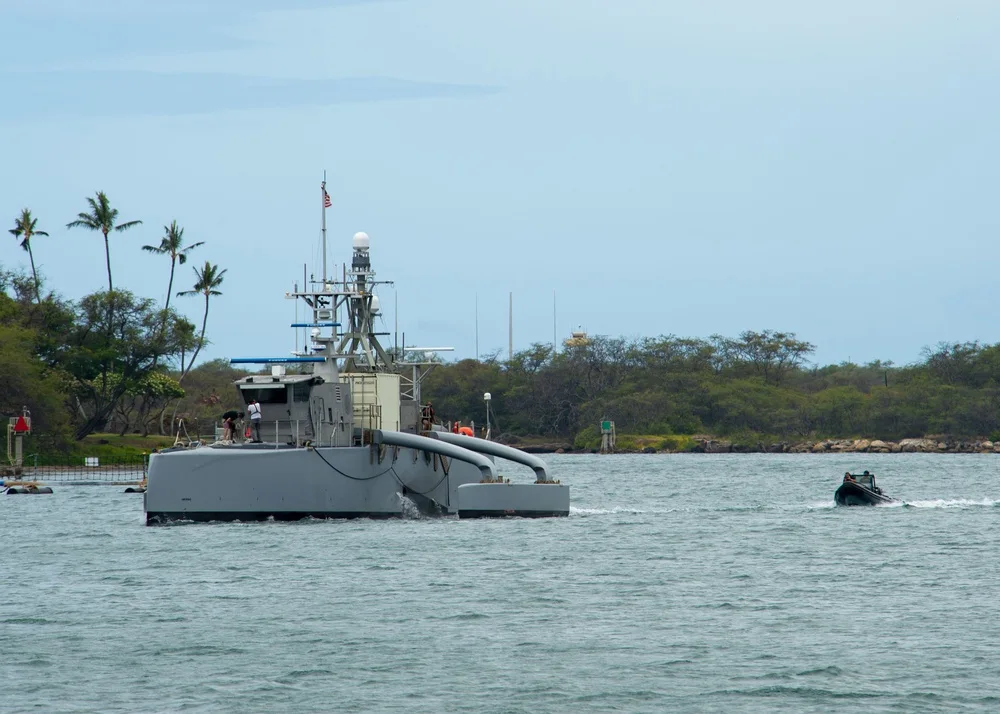
NAVSEA's 2022 RIMPAC report identifies Sea Hunter, Seahawk, Nomad and Ranger as participating unmanned vessels [2]. The historical example matters because integration with a wider fleet is a distinct activity from demonstrating an isolated vehicle. It does not prove that every function was autonomous or that every participating vessel had identical equipment.
The accompanying Sea Hunter photograph is from that period. It illustrates the platform and its physical arrangement, not a newly announced deployment or a claim about its present configuration.
Underwater: information may arrive after the vehicle
NOAA describes AUVs collecting and storing survey information onboard, with data retrieved after recovery [1]. That can be entirely suitable for mapping. It is a different service from a tethered ROV providing a live view to its operators. Choosing between them begins with when the user needs the result and how much interaction the task demands.
Underwater links and navigation references also require different assumptions from their airborne equivalents. NOAA's engineering explainer describes acoustic communication, limited light, pressure housings and corrosion as practical design concerns [3]. No single “autonomy level” captures those physical constraints.
Worked example: inspecting a harbour structure
Imagine a fictional authority comparing two ways to inspect a harbour wall. One approach produces a repeatable survey dataset for later analysis. Another lets an operator examine an unexpected feature immediately and decide whether a closer look is needed. Neither is automatically better; they deliver different information services.
The authority must also consider access, handling equipment, the support vessel or shore team, data processing and weather-related interruptions. Counting only the minutes when the robot is in the water omits much of the work. A compact vehicle with a demanding recovery arrangement may have a larger operational footprint than its dimensions suggest.
Launch and recovery belong in the capability claim
A vehicle that can operate in certain conditions may not be safely handled in all of those conditions. The supporting equipment and people have their own limits. A sea-state claim should therefore say whether it concerns transit, useful sensing or launch and recovery, rather than allowing one limit to imply all three.
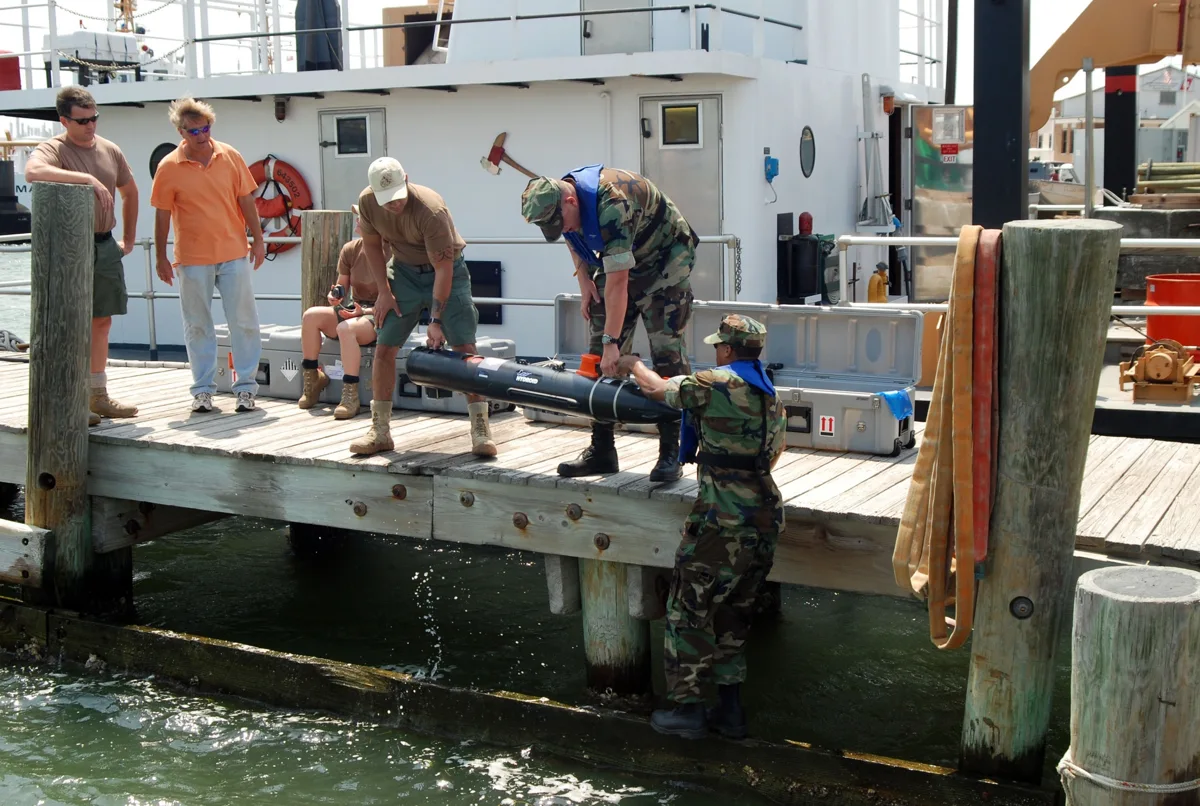
Photographs of preparation are useful for this reason. The underwater-vehicle image shows people and handling arrangements around a real system. It does not establish staffing for other vehicles, but it makes visible the support activity that a clean product rendering often excludes.
Standards and approvals need their own context
In May 2026, the International Maritime Organization adopted a non-mandatory MASS Code for autonomous surface shipping, taking effect on 1 July 2026 [4]. Its stated commercial cargo-ship scope should not be presented as a universal approval for naval drones. The example shows the importance of a functional safety and supervision framework while also demonstrating why regulatory scope must be stated carefully.
How to judge a maritime demonstration
- Identify whether the system is surface, tethered underwater or untethered underwater.
- State the human role during planning, operation and recovery.
- Distinguish collection of data from its delivery and interpretation.
- Separate vehicle operating limits from the handling system's limits.
- Record the payload and support arrangements actually demonstrated.
Does an AUV need no operator?
No. Untethered operation shifts human work toward preparation, supervision where available, recovery and data assessment. It changes the distribution of work rather than eliminating it. The most informative comparison measures the complete service delivered by the vehicle and its supporting team.
Publication history
- — Added an illustrated guide with practical examples and linked primary sources.
Suggest a correction to this entry
Follow the evidence
Source types identify who makes the claim. Programme milestones and supplier statements should be read in context.
- NOAA — What is an AUV? (opens in a new tab)Government technical explainer
- NAVSEA — Unmanned surface vessels at RIMPAC 2022 (opens in a new tab)Operator announcement
- NOAA — How robots explore the deep ocean (opens in a new tab)Government technical explainer
- IMO — Adoption of the non-mandatory MASS Code, May 2026 (opens in a new tab)International authority