The link is part of the system
A remotely operated vehicle is only one component of a wider information system. People need to send instructions, receive status and obtain useful mission data. These exchanges can have very different demands. A small position report is not the same as a continuous high-definition video stream, and a delayed photograph is not the same as a delayed control command.
It helps to separate three qualities. Capacity describes how much information a connection carries. Latency describes how long delivery takes. Availability describes whether the connection can be used when required. A system can perform well on one measure and poorly on another. Security adds further questions about who can read, alter or impersonate communications.
Four information flows
- CommandsInstructions and acknowledgements.
- Vehicle statusHealth, position and progress reports.
- Mission dataImages, measurements and survey products.
- Support servicesConfiguration, records and approved updates.
These flows may share equipment, but they should not be treated as one undifferentiated “data link”. The user needs to understand which functions depend on continuous connectivity and which can tolerate interrupted transfer. This is a system-design and evaluation question, not a promise that one radio can provide every service in every environment.
For example, a fictional environmental-survey aircraft might continue its approved collection task while storing detailed images onboard. The operator could receive only status messages during part of the flight. That would be a very different service from continuously watching every image, even if both arrangements were described as connected operation.
Range numbers require context
The distance a vehicle can travel and the distance over which a particular connection works are separate specifications. A platform may physically reach somewhere without being able to deliver live information from it through the installed communications package. Equally, a long-distance network connection does not supply the energy needed to reach that location.
IAI lists both direct line-of-sight and satellite communications for Heron [1]. The example shows why descriptions should identify the path being used. It does not establish that every delivered Heron has identical equipment, service access or authorisations. Advertised platform options must be distinguished from an operator's actual configuration.
A chain of services can also introduce dependencies beyond the aircraft. The remote station, its network connection, a service provider and the receiving organisation all contribute to whether the information reaches its user. Assessing only the airborne transmitter misses those boundaries.
Encryption and reliability answer different questions
Encryption is intended to protect the confidentiality of information. Authentication helps establish who is communicating; integrity mechanisms help detect alteration. These properties do not make a signal continuously available or remove the effects of congestion, obstruction or equipment faults. Claims such as “secure” and “resilient” need separate explanations.
An informative evaluation records what remained available and what degraded, with the installed equipment and conditions stated. A manufacturer listing encryption is not evidence of universal immunity to interference. Nor does the presence of two links automatically prove independence: both could rely on the same power source, software component or ground facility.
Underwater communications change the assumptions
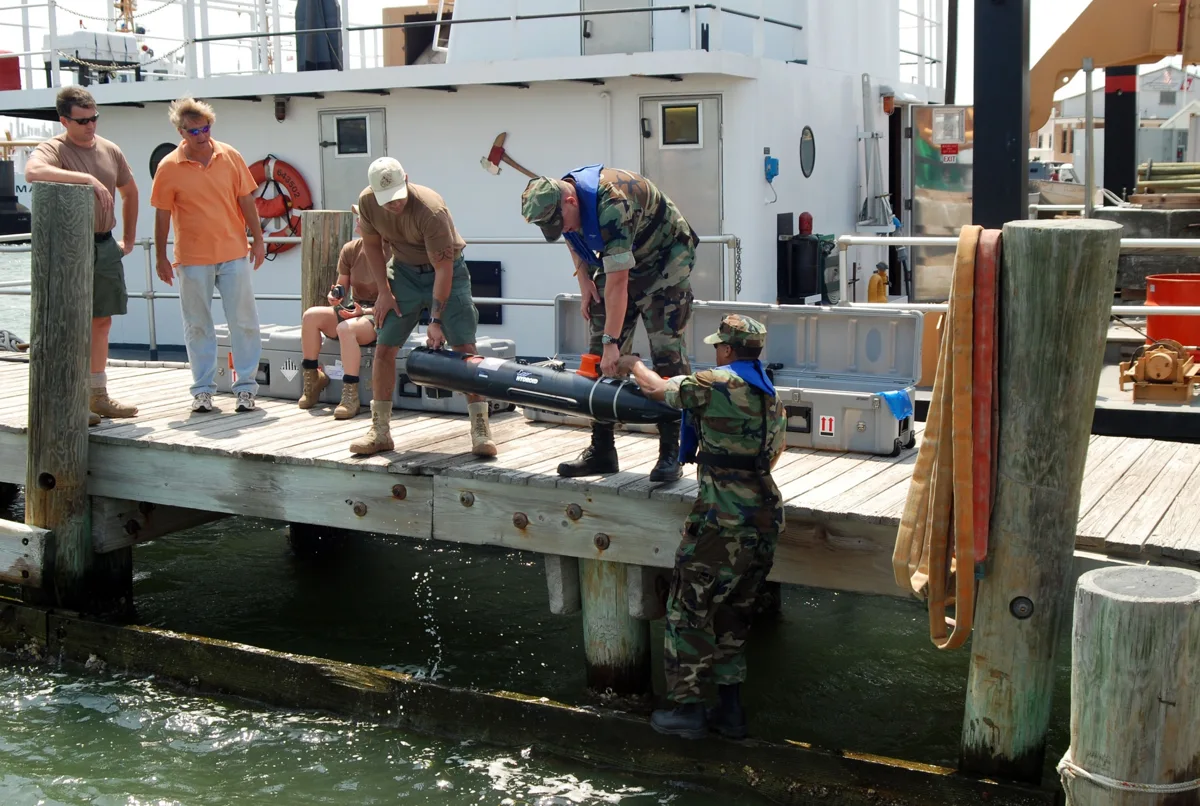
NOAA's technology explainer describes why submerged robots commonly rely on acoustic communication or a tether rather than ordinary airborne radio arrangements [2]. A tethered ROV can exchange substantial data through its cable, while an untethered vehicle may store much of its survey data for later retrieval.
This changes what supervision means. A delayed or intermittent status update is not equivalent to a live video connection. A capability assessment must match the expected interaction to the communication method. The sea is not simply airspace with a different vehicle shape.
Worked example: when a better camera is not the answer
Suppose a fictional inspection team receives only one image in every several seconds, although the aircraft records many more onboard. Replacing the camera with a higher-resolution model might increase the amount waiting for transfer without improving what the team sees during the inspection. The constraint could be the network or the chosen service, not image capture.
The team should first define the information product it needs: occasional verified images, live viewing or a detailed dataset after return. The comparison then becomes meaningful. The desired output determines which combination of onboard recording, communication and review is useful.
What happens when contact is lost?
There is no universal answer. The response depends on the vehicle, approved procedures, configuration and environment. It must be documented and evaluated for the particular system. A generic claim about returning automatically does not demonstrate that every required input remains available during a loss of contact.
Questions to ask before comparing systems
- Which data is live, which is delayed and which remains onboard?
- What capacity, latency and availability were demonstrated together?
- Which network services and ground equipment are required?
- What is the approved behaviour when communication is interrupted?
- Who can access, retain and export the collected information?
The useful measure is successful delivery of the required information and control service. A peak data rate or a long-range headline cannot describe that service on its own.
Publication history
- — Expanded into an illustrated guide with worked examples, comparison visuals and linked primary sources.
Suggest a correction to this entry
Follow the evidence
Source types identify who makes the claim. Programme milestones and supplier statements should be read in context.
- IAI — Heron payload and communication options (opens in a new tab)Manufacturer claims
- NOAA — How robots explore the deep ocean (opens in a new tab)Government technical explainer