A useful observation answers a question
A payload is not valuable simply because it produces a sharp picture. It must help someone answer a question with adequate confidence and within a useful time. Is a harbour approach clear? Has an inspection found a change? Does an apparent object need a closer look? The necessary evidence differs for each task.
Detection, classification and identification are therefore distinct. Detection establishes that something may be present. Classification places it in a broad category. Identification supports a more specific conclusion. An image sufficient for the first may be wholly inadequate for the last. These words should not be treated as interchangeable performance claims.
Different sensors describe different properties
| Sensor | Useful contribution | Interpretation limit |
|---|---|---|
| Visible-light camera | Colour, texture and visual context | Lighting and obscuration affect the view |
| Thermal imager | Patterns in infrared radiation | Not a view through walls or ordinary glass |
| Radar | Observations based on radio reflections | Returns require interpretation and context |
| Sonar | Acoustic observations underwater | Not equivalent to a photographic image |
Visible-light imagery is intuitive because it resembles human vision. Thermal imagery represents differences in infrared radiation and can reveal patterns difficult to distinguish in ordinary light. Radar and sonar measure reflected electromagnetic or acoustic energy respectively; their products require their own interpretation. No single view is a complete account of the environment.
Thermal cameras are particularly prone to overstatement. FLIR explains that ordinary thermal imaging does not reveal people through walls, and that common glass behaves very differently for thermal and visible-light cameras [1]. An apparent thermal feature can reflect the surface and viewing conditions. It is not automatically a direct measurement of the hidden object a viewer imagines.
Carrying several sensors is not the same as fusion
A screen with two feeds provides multiple observations. Fusion goes further: it associates information so that measurements contribute to a consistent picture. The association must take account of position, time, viewing geometry and uncertainty. If these are wrong, the combined display can look more convincing while becoming less accurate.
Consider a fictional port inspection. One camera records a small workboat beside a pier; a separate sensor records a moving object seconds later. Without aligned times and positions, an operator might merge two different objects or count one boat twice. A confident-looking symbol on a map should not hide that uncertainty.
This is why calibration and metadata matter. A measurement needs context: when it was made, where the sensor was, which direction it pointed and how it was processed. A high-resolution image without those details may be attractive but difficult to compare with yesterday's survey.
Real example: selectable payloads on Heron
IAI describes Heron as a multi-sensor platform capable of carrying customer-furnished equipment, with line-of-sight and satellite communication options [2]. This illustrates the difference between a platform and a particular sensor configuration. “Heron imagery” is not one fixed product: the installed payload, processing and communication arrangements determine what reaches the user.
The source is a manufacturer description. It does not establish that every operator has every advertised sensor or that all combinations share the same performance. A specific configuration needs its own evidence.
Real example: cameras and sonar underwater
NOAA describes AUVs carrying cameras, sonar and environmental sensors [3]. These can contribute different products from the same survey. A camera provides close visual context; sonar supports acoustic mapping where a camera's view may be limited. The resulting datasets must still be located and interpreted correctly.
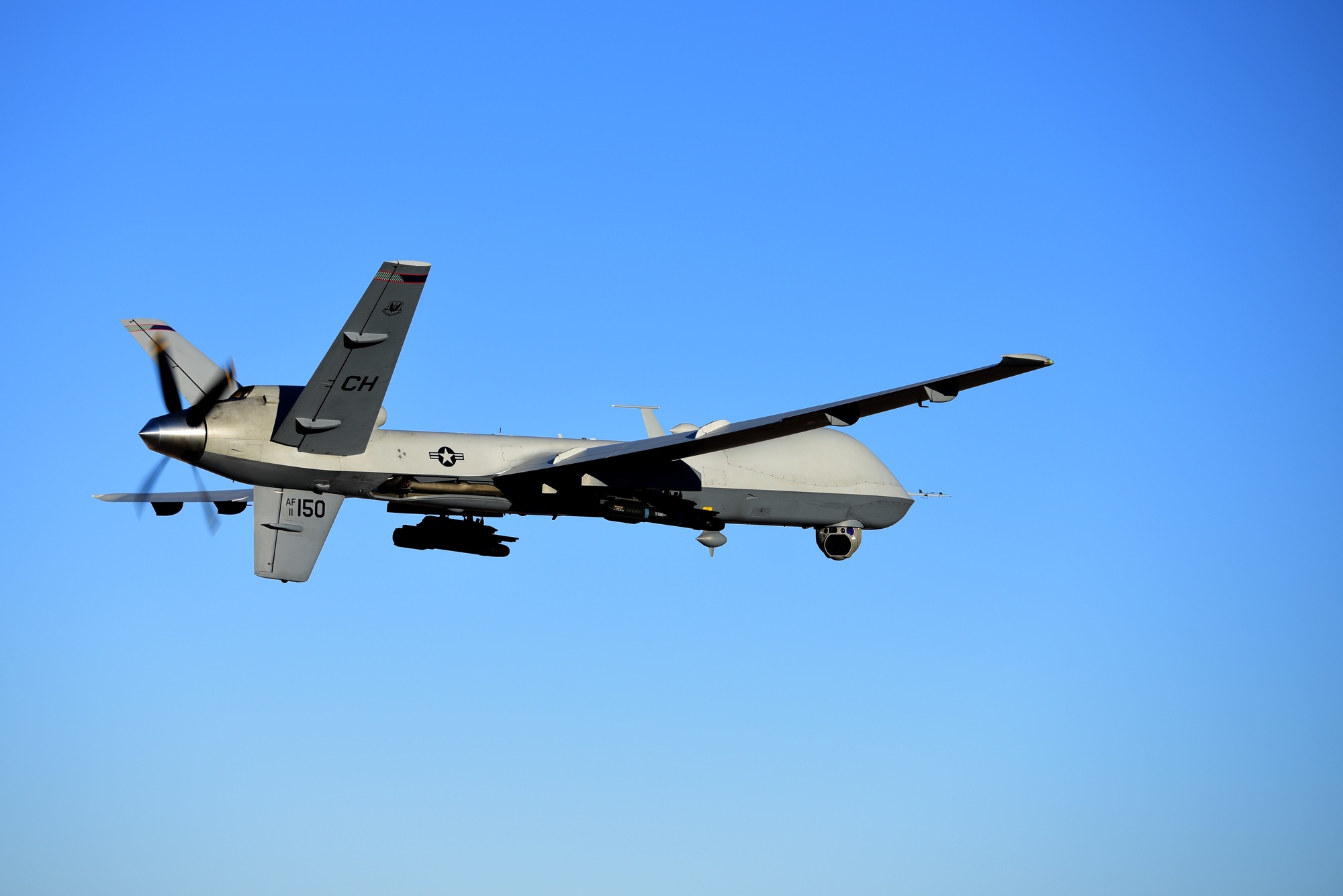
The scientific examples explain the physical constraints shared with defence systems. They are not evidence that a particular naval vehicle carries the same equipment. Similarly, the aircraft photograph on this page provides platform context; it is not a demonstration of an unseen sensor's performance.
Image quality is a chain
The final result depends on more than the detector. Motion, vibration, atmospheric or water conditions, processing, compression and display choices can all affect interpretation. Digital enlargement makes pixels larger; it does not guarantee that missing detail has become evidence. A compelling cropped image should be accompanied by its context rather than treated as a universal range demonstration.
Timing also matters. A detailed survey delivered after recovery can be useful for planning, while a rapidly changing situation may require a less detailed but timely product. “Real time” needs a stated delay and a description of what is transmitted. The best sensor on paper may not provide the most useful information through the available link.
Questions for a credible comparison
- What conclusion was the observer required to reach, and how was correctness checked?
- Which payload, software and processing settings produced the result?
- Are false detections, missed observations and ambiguous cases included?
- Does the comparison use similar environments and equivalent output quality?
- Can the user trace a combined result back to its original observations?
Can AI remove uncertainty from sensor data?
No. Automated interpretation can prioritise material or suggest a classification, but it remains dependent on the information captured and the situations represented in evaluation. A confidence score is not proof of truth. Useful systems make disagreement and uncertainty visible so that a person can judge when more evidence is needed.
Publication history
- — Expanded into an illustrated guide with worked examples, comparison visuals and linked primary sources.
Suggest a correction to this entry
Follow the evidence
Source types identify who makes the claim. Programme milestones and supplier statements should be read in context.
- FLIR — What thermal imaging can and cannot see through (opens in a new tab)Manufacturer technical explainer
- IAI — Heron payload and communication options (opens in a new tab)Manufacturer claims
- NOAA — What is an AUV? (opens in a new tab)Government technical explainer